
On this page
The short version
- Anthropic's Economic Index is best read as a demand signal, not a jobs report; the unit of demand has shifted from the keyword and click to the artifact.
- 93% of Claude conversations now produce an artifact, the concrete output a person takes away, not a page they click to.
- Purely informational intent, like how-to and definitions, is being absorbed into AI answers, while transactional and branded intent still needs a destination to resolve.
- The content that survives is audience-facing writing and high-judgment strategy; AI cleanly absorbs low-judgment, commodity work like definitional explainers and mechanical translation.
Anthropic published its June 2026 Economic Index on June 26, and most of the coverage read it as a jobs report: what share of your work can AI do, and should you be worried. That is in the report, and I will get to it. But reading this as a labor study misses the more useful document hiding inside it. Anthropic rebuilt how it measures AI usage this quarter, and in doing so it produced the first serious, public, privacy-preserving picture of what people actually ask AI to make. For anyone in search or e-commerce, that is not a jobs report. It is a demand signal, and it is telling you the unit of demand has changed.
93% of Claude conversations now produce an artifact, the concrete output a person takes away, not a page they click to.1
Why call a jobs report a demand signal?
Anthropic changed how it measures AI usage this quarter, not just what it found, and that shift is what turns a labor report into a demand signal. Three method changes turn this edition from a snapshot into an instrument. First, the team moved from the seven-day samples earlier reports drew on to continuous sampling, fine enough to see usage hour by hour.2
Second, it introduced an artifact classifier that labels the primary output of every conversation, sorted into more than thirty categories.1 Third, it linked a survey of roughly 9,700 users to their actual usage logs through a privacy-preserving pipeline, so stated attitudes can be checked against observed behavior.4
Set the labor findings aside for a moment and look at that as a data engineer would. Continuous sampling is a stream, not a batch. An output classifier is a demand taxonomy.
A survey linked to logs is stated intent joined to revealed intent on a common key. That is the architecture of a demand-sensing system, and Anthropic just ran it across a large slice of global AI usage and published the shape of the results. The labor story is one query against that dataset. The demand story is the dataset itself.
What is the new unit of demand?
The new unit of demand is the artifact. Anthropic’s classifier found that 93% of Claude conversations produce one, and the mix is dominated by exactly the outputs that used to be someone’s search-and-read task: explanations at 17%, documents and reports at 15%, and guidance at 11%, with analyses, emails, apps, plans, and code filling out the tail.1
Group them and conversational outputs like explanations and guidance are about a third of all sessions, written deliverables like documents and presentations are about another third, and code and technical work about a sixth.1
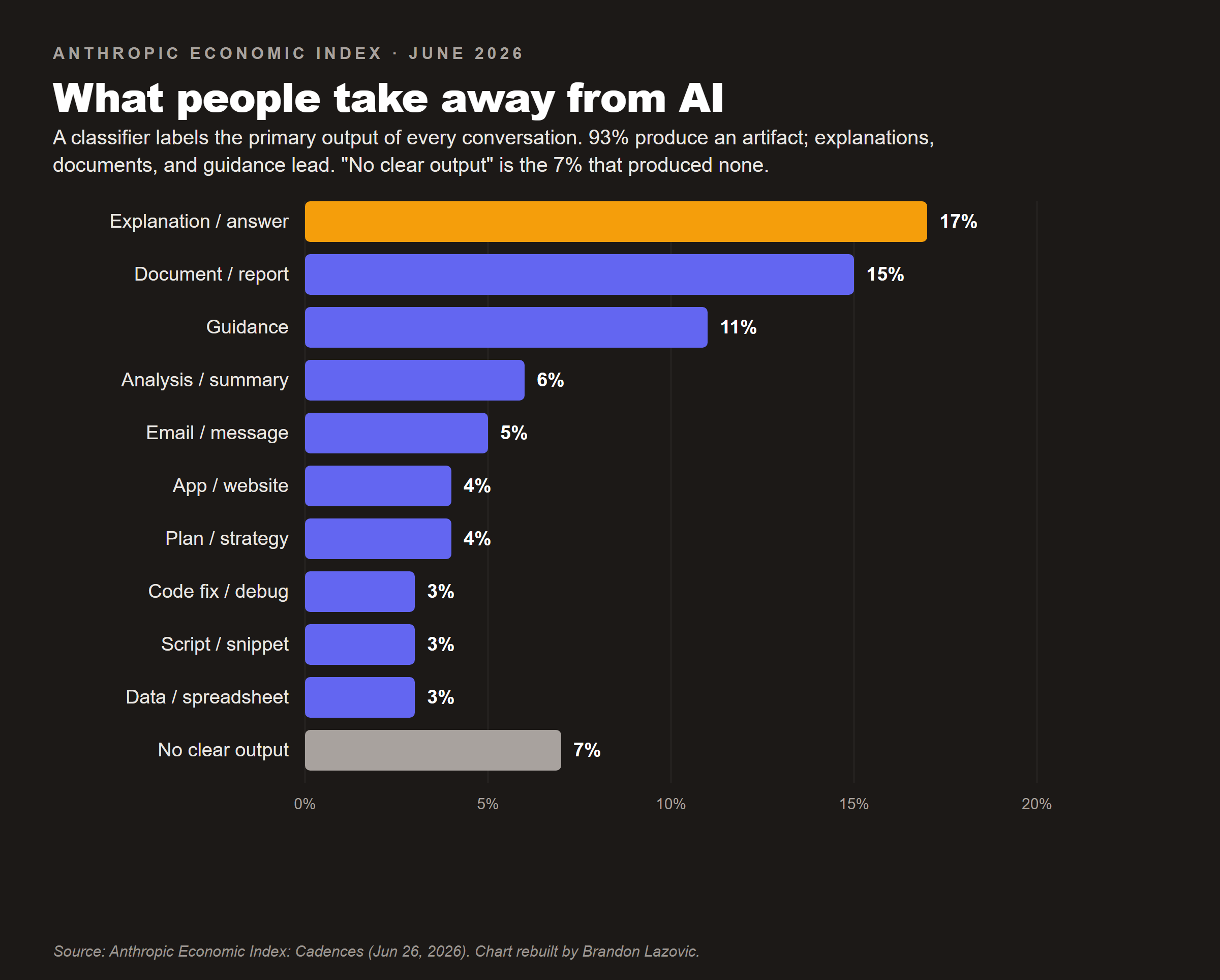
Here is the reframe, and I will label it as mine rather than Anthropic’s: this is the unit of demand changing under our feet. The classic SEO chain was keyword, then a ranked page, then a click, then a read. The chain the artifact classifier describes is task, then an assembled output, with no SERP in the middle and often no click at all. I call this the artifact as the unit of demand. The strategic consequence is blunt.
Your content’s job is no longer to be the destination a person lands on; it is to be an ingredient the model reaches for while assembling someone’s artifact. You can be cited, quoted, or synthesized without ever being visited, and you can be the source of an answer you get no traffic for. I have watched this happen on client pages: the content is clearly the basis an assistant used to answer, and the click never arrives.
Which search intents is AI absorbing, and which still need a destination?
Anthropic’s Economic Index answers this better than any keyword tool, because it splits each artifact type by whether the conversation was work, personal, or coursework, a primitive it introduced in its January 2026 index.31 Read that split as an intent-migration map. The outputs that are overwhelmingly personal, recipes, creative writing, and general guidance, are informational intents that AI now satisfies end to end; more than 80% of conversations producing those were personal use.1
The outputs that skew heavily work-related, database queries at 82%, blog and article drafts at 81%, and marketing content at 80%, are the commercial-content jobs that agencies and content teams sold by the yard.1 And a band in the middle, plans and strategies at 44% work and 49% personal, or translation at 42% work and 44% personal, are genuinely mixed.1
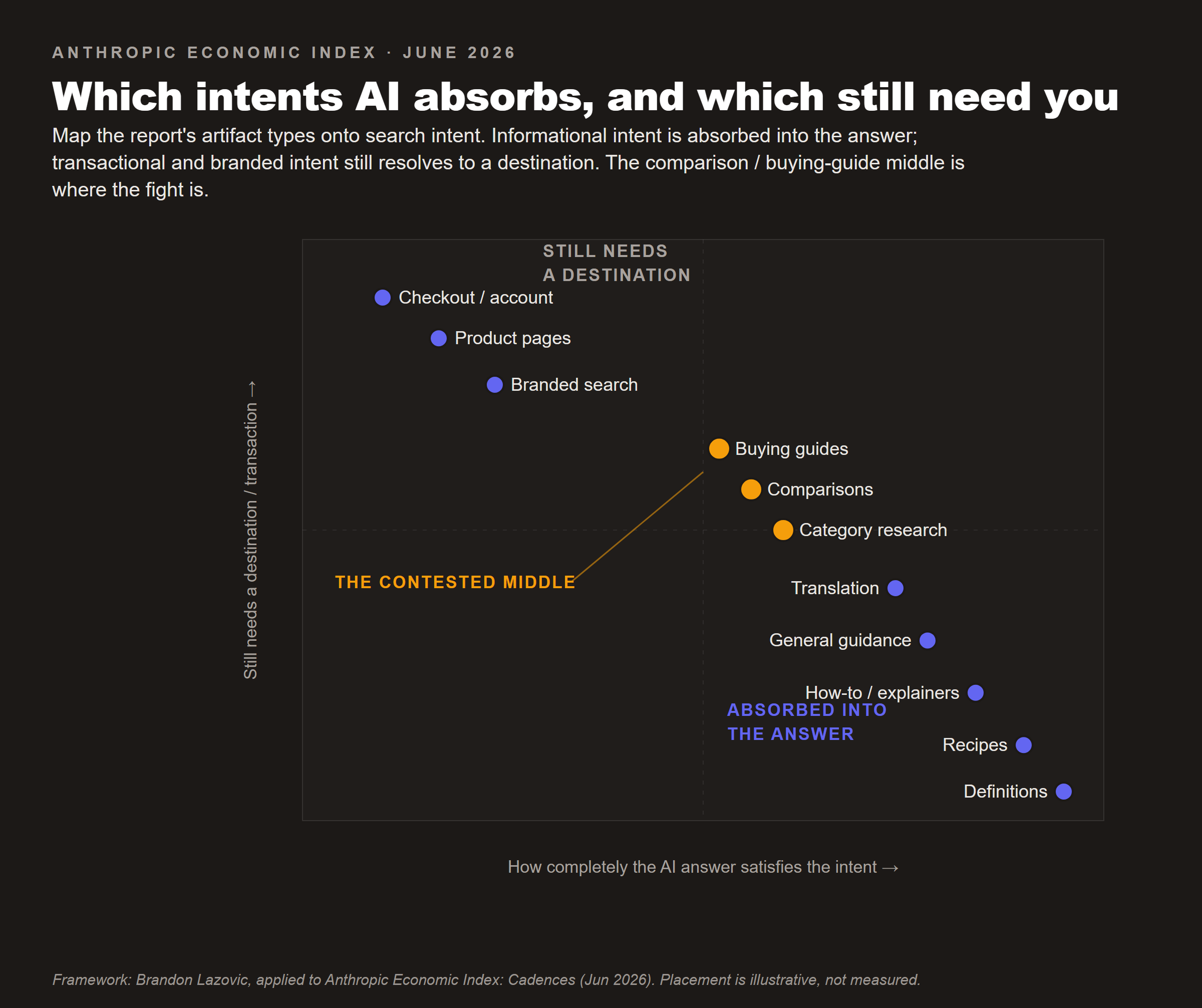
Mapping those categories onto search intent is my synthesis, not the report’s, so treat the placement as a strategist’s read rather than a measured result. The pattern it exposes is the useful part. Purely informational intent, the how-to, the definition, the quick explanation, is being absorbed into the artifact and will not reliably send you a click.
Transactional and branded intent, the specific product, the checkout, the account action, still resolves to a destination because it needs one. The contested middle, comparisons, buying guides, and category research, is where the fight actually is, because that is where an AI answer can either cite your structured data or replace your page with its own synthesis.
I call this the intent-migration map, and that contested middle is where structured, machine-legible content earns its keep. This matches what I see in client work: the comparison and category pages that hold up in AI answers are consistently the ones with the most complete, structured first-party data, real specifications, live availability, and genuine attributes; the thin, templated ones get synthesized around.
When does demand actually fire?
Demand fires on a clock, and Anthropic’s Economic Index is the first public dataset to show that clock at hourly resolution. Personal use of Claude jumps from around 35% of conversations on weekdays to just under 50% on weekends.1 Within a day, people ask for news around 7 a.m., business correspondence traces the workday and peaks at 10 to 11 a.m., recipe requests run 2.3 times their average at 6 p.m., and sleep advice peaks in the hours before dawn.1
Tie usage to the calendar and it gets sharper still: in the US, tax-related conversations spiked to roughly seven times their own May average just before the April 15 deadline, then collapsed the day after; on the single peak day the report counts them at eight times an average May day.2
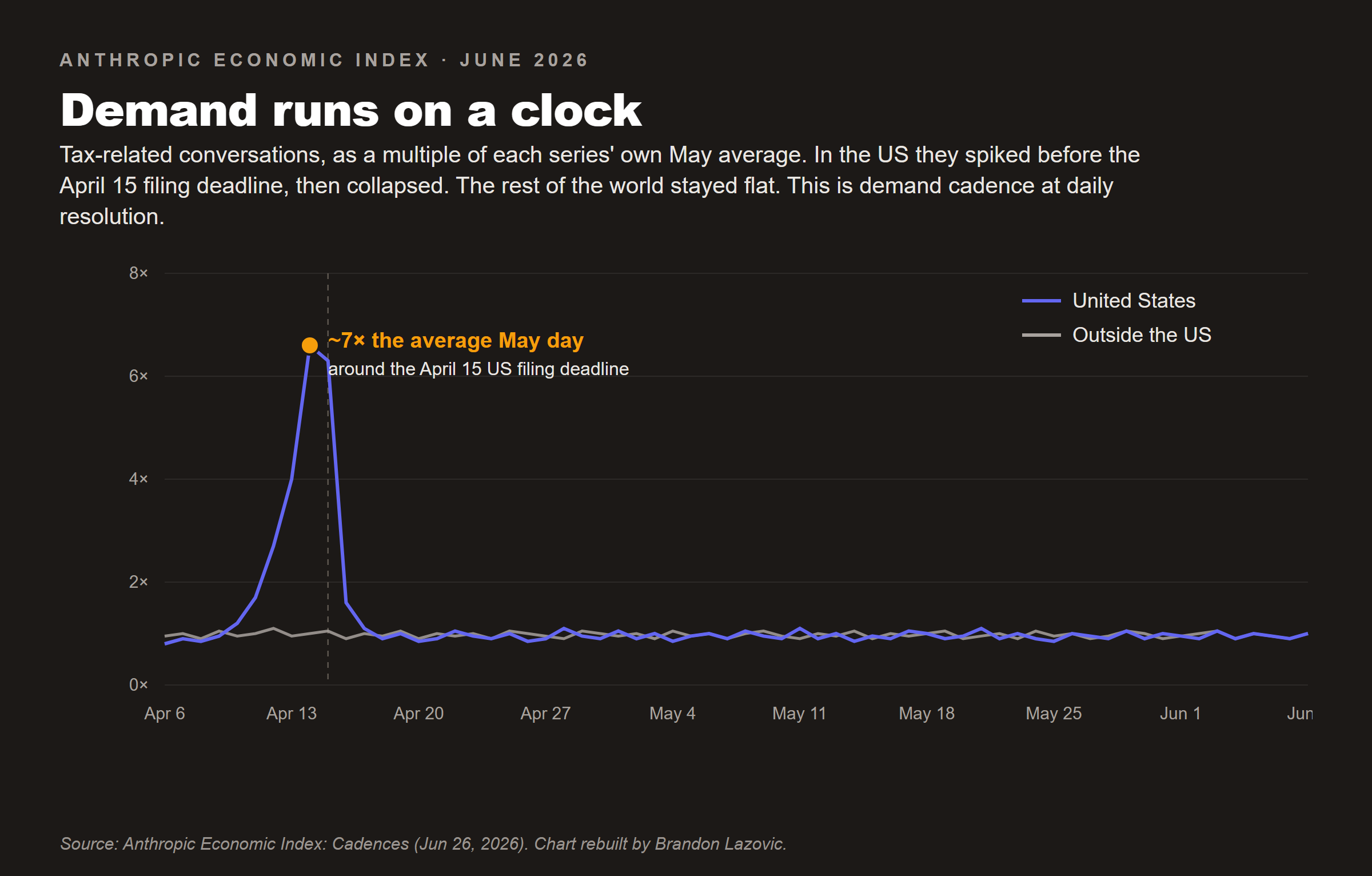
I call this legible rhythm demand cadence, and it matters for two reasons. The obvious one is timing: if you merchandise, publish, or bid, the cadence of an intent tells you when attention is actually present, at a granularity monthly search volume flattens.
The subtler and more important one is coverage. Much of this demand was never a search query. “Plan my meals around what is already in my fridge” was not a keyword; it was a task nobody could express to a search box, so it never showed up in your volume data at all.
Analysts have talked for years about “dark demand” that never becomes a query; what this report adds is not the idea but the measurement, at hourly resolution. AI-usage telemetry captures latent intent that search demand never recorded, which means treating it purely as a keyword-research substitute undersells it. It is a new demand surface, not a new view of the old one.
Which content work survives?
The content work that survives is the work that keeps a human in the loop. Three of Anthropic’s findings stack into a single, defensible answer. First, autonomy is driven by the product, not the model: across almost all output types, Claude Code delegates far more than chat, and the gap persists even when you compare the same underlying model.1
The vivid version is that the median blog post produced in chat took 13 rounds of back and forth, while the median blog post produced in Claude Code took a single human prompt.2
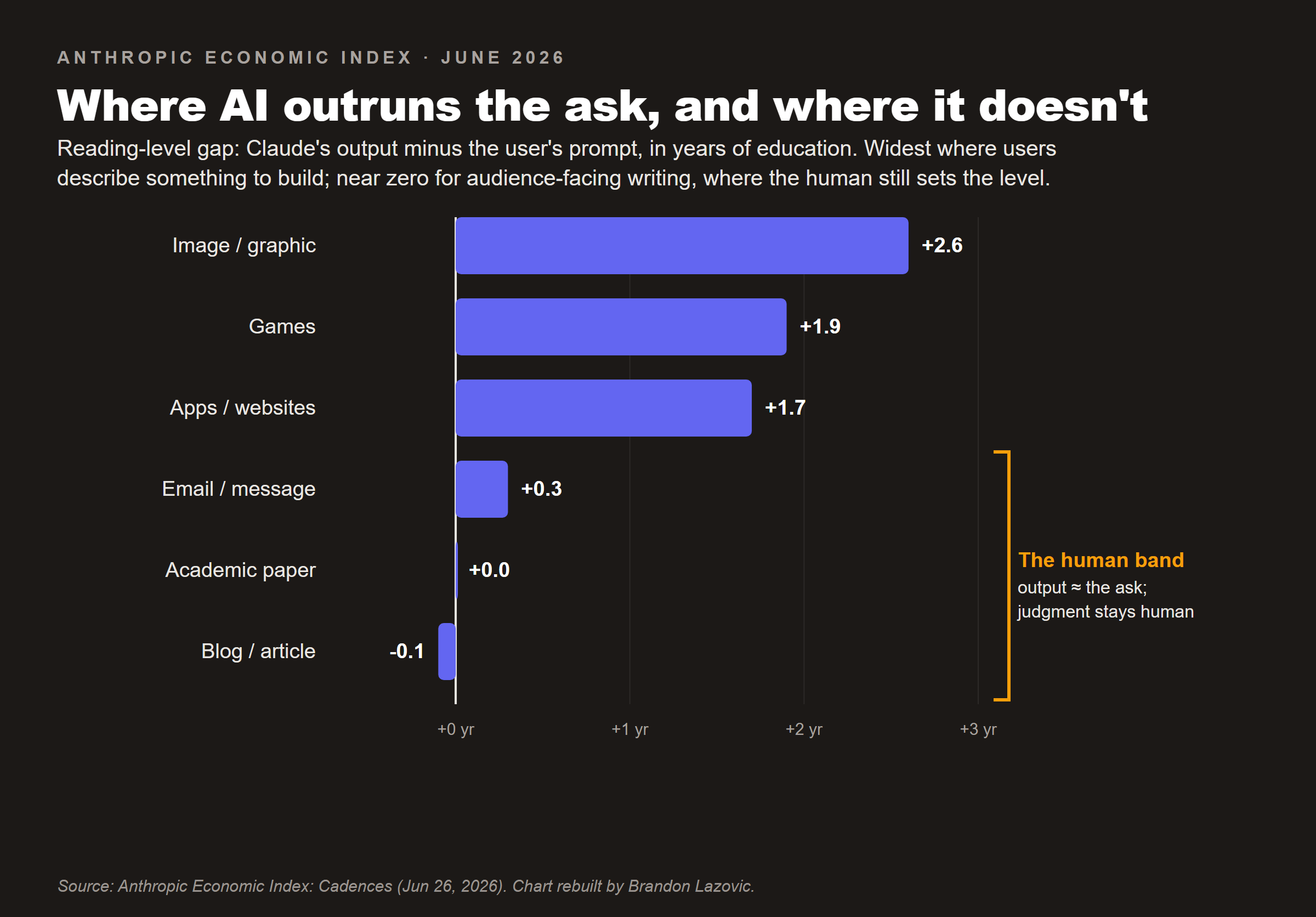
Second, Claude answers above the level it was asked. Its output runs roughly one year of education higher than the prompt on average, and the gap is widest where the user describes something to be built: images and graphics at plus 2.6 years, games at plus 1.9, apps and websites at plus 1.7.1
But the gap is near zero for audience-facing writing: blogs at minus 0.1, academic papers at plus 0.0, email at plus 0.3.1 Third, the outputs where the human delegates least and stays most involved are the low-autonomy ones like translation, simple Q&A, and calculation.1 Those are exactly the commodity informational content that content farms mass-produced.
Put those together, and I will flag the conclusion as my inference, though it tracks closely with what I see in client work. The content work AI absorbs cleanly is the low-judgment, low-autonomy, commodity middle: the definitional explainer, the mechanical translation, the thin how-to. The content work that stays human is audience-facing writing where the model’s sophistication does not exceed the author’s intent, and high-judgment strategy where the specification is the hard part.
Are the people closest to AI panicking?
No, and the direction of the surprise is the interesting part. Among the linked survey respondents, about six in ten expect AI to handle a larger share of their work next year than it does today, and more than a third expect it to do most or nearly all of their tasks.1
Yet the people who delegate to AI the most, the heaviest automation users, are the most optimistic about their own pay, job security, and ability to find a new job, and the share who say AI is increasing the market value of their skills rises with how much they automate.1 Worry concentrates on others, especially junior colleagues, more than on oneself.1
The reason this matters for a commerce or content team is not the reassurance. It is that the people with the most exposure to AI are leaning in, not pulling back, which means the behavior change this report captures is more likely to accelerate than to revert. Planning as if the artifact economy is a phase would be a mistake.
What should an SEO or e-commerce team do Monday?
Treat Anthropic’s Economic Index as an operating brief, not a headline. The moves below are my translation of the findings into actions, not Anthropic’s recommendations; several are already how I steer client roadmaps.
| If the report says | Then the move is |
|---|---|
| The artifact is the unit of demand | Structure content to be extractable as an ingredient: answer-first sections, one claim per heading, server-rendered schema, clean tables. Stop optimizing solely for the landing-and-reading click. |
| Informational intent is being absorbed | Audit your informational content by intent. Concede the commodity how-to to the answer engines; invest where judgment, first-party data, or experience makes you the source worth citing. |
| Demand runs on a cadence | Add a time-of-intent lens to merchandising and publishing. Align inventory, offers, and content freshness to when an intent actually fires, not just to monthly volume. |
| Comparisons and buying guides are contested | Make your comparison and category content the most structured, most complete, most current version available, so an AI answer cites your data instead of synthesizing around you. |
| Audience-facing writing keeps a human | Keep a human on the voice-and-judgment content; use AI to accelerate the commodity middle, not to replace the work that is your differentiation. |
The through line is that machine-legibility stops being a nice-to-have. When the output is an artifact and not a click, the content that gets used is the content a model can parse, trust, and lift cleanly. That is the same structural work I keep coming back to: agents read structure, not pixels.
The answer economy still needs answer-worthy inputs
The most-cited hope in Anthropic’s survey, held by roughly two-thirds of respondents, was not replacement; it was that work would still matter, with humans and AI collaborating on things worth doing.1 That is a fitting note for where this leaves content and commerce. The artifact economy does not remove the need for good source material; it raises the stakes on it.
An AI answer is only as good as the inputs it can find and trust, and those inputs are structured data, first-party evidence, and genuine expertise. The demand did not disappear when the click did. It moved into the artifact, and the question for every merchant and publisher is whether their content is good enough, and legible enough, to be in it.
Terms defined here
- Artifact as the unit of demand. The shift, in AI-mediated discovery, from the keyword and the click to the artifact, the concrete output a person takes away from an AI session, as the smallest measurable unit of user demand. Where classic SEO measured demand as a query resolved by a ranked page, the answer economy resolves demand as an assembled artifact, so the strategic question becomes whether your content is an ingredient the model reaches for rather than a destination it links to.
- Demand cadence. The recurring temporal rhythm, hourly, weekly, or seasonal, at which a specific intent fires. Continuous AI-usage telemetry makes cadence legible at a resolution that aggregated monthly search volume blurs, and it exposes latent intent that was never phrased as a search query, which makes it usable as a demand-sensing signal for merchandising and content timing.
Sources
Anthropic Economic Index report: Cadences (June 26, 2026).
Related reading
From the Daily Pulse
Explore with