Google Requires Disclosing Incentivized Reviews. Schema Has No Field For It.
Sources: Google Search Central, Google Search Console Help, and the schema.org machine-readable vocabulary, fetched 2026-08-07.
The short version
- Google's review-snippet documentation bars fake or undisclosed incentivized reviews from structured data markup, on the same page that warns a guideline violation can trigger a manual action.
- Schema.org lists exactly nine properties with Review in their domain: associatedClaimReview, associatedMediaReview, associatedReview, itemReviewed, negativeNotes, positiveNotes, reviewAspect, reviewBody, and reviewRating. None of them can record that a review was incentivized.
- The properties that look like a fix, incentiveAmount, incentiveType, and incentivizedItem, all belong to FinancialIncentive, a type covering rebates and subsidies, not reviews.
- Most product reviews arrive through a syndication vendor the merchant does not operate, which puts the compliance gap on a program the merchant approved once and may no longer track. That half of the claim is reasoning, not measurement.
Google’s structured-data guidelines for review snippets bar one specific thing: a review collected in exchange for money, a discount, or a free product, where the review’s incentivization goes undisclosed.1 Because the rule names structured data markup specifically, alongside the page itself, an incentivized review cannot simply live in a product’s JSON-LD unnoticed. Schema.org, the vocabulary that markup is written in, has no property built to carry the disclosure that rule demands. Mark up who wrote a review, what it rated, what it said, and the vocabulary supports every field. Where a site’s reviews arrive through a third-party syndication vendor, that gap becomes the merchant’s problem the moment Google notices, since nothing in the vocabulary lets a merchant also mark up why the reviewer was willing to say it.
Schema.org lists exactly nine properties with Review in their domain. Zero of them can record that a review was incentivized.
What does Google’s structured-data guidance actually say about incentivized reviews?
Google’s review-snippet documentation states the rule in one line: “Don’t include fake or undisclosed incentivized reviews on your page or in your structured data markup.”1 Within the same page, two examples spell out what counts, the first a review not based on a genuine experience, the second a review written for money, a discount, a voucher, or free products, where the incentive is not disclosed clearly and prominently.1 If a site violates that guideline, Google may take a manual action against it, with reconsideration available only once the problem is fixed, per the same page.1 As of this fetch, the document carries a last-updated date of July 24, 2026, roughly two weeks before this piece went to draft, so the wording above is what the page reads today rather than an old capture.1
Which schema.org property lets a merchant mark a review as incentivized?
None. The current machine-readable schema.org vocabulary, the same file search engines treat as the specification, lists exactly nine properties with Review in their domain: associatedClaimReview, associatedMediaReview, associatedReview, itemReviewed, negativeNotes, positiveNotes, reviewAspect, reviewBody, and reviewRating.2 Not one of the nine touches disclosure, compensation, or how a review was obtained. Google’s own required fields for the feature narrow that further to three: author, itemReviewed, and reviewRating.1 Say who reviewed a product and what score they gave it, and the schema is ready for you. There is no field for why.
Why does searching the vocabulary for “incentive” lead people to the wrong answer?
A search for incentive inside the vocabulary turns up matches, and every one of them belongs to the wrong type. Under FinancialIncentive, a class covering rebates and subsidy programs for goods and services, sit incentiveAmount, incentiveStatus, incentiveType, and incentivizedItem, none of them related to a product review.2 Two more matches, incentiveCompensation and incentives, belong to JobPosting instead, further still from a customer review.2 Stop at the property name alone and the false positive looks real, because the field appears to exist. Check the domain it actually belongs to, though, and it disappears. Only two properties in the entire vocabulary match “disclos,” correctionsPolicy and verificationFactCheckingPolicy. Both belong to news organizations; neither touches reviews.2
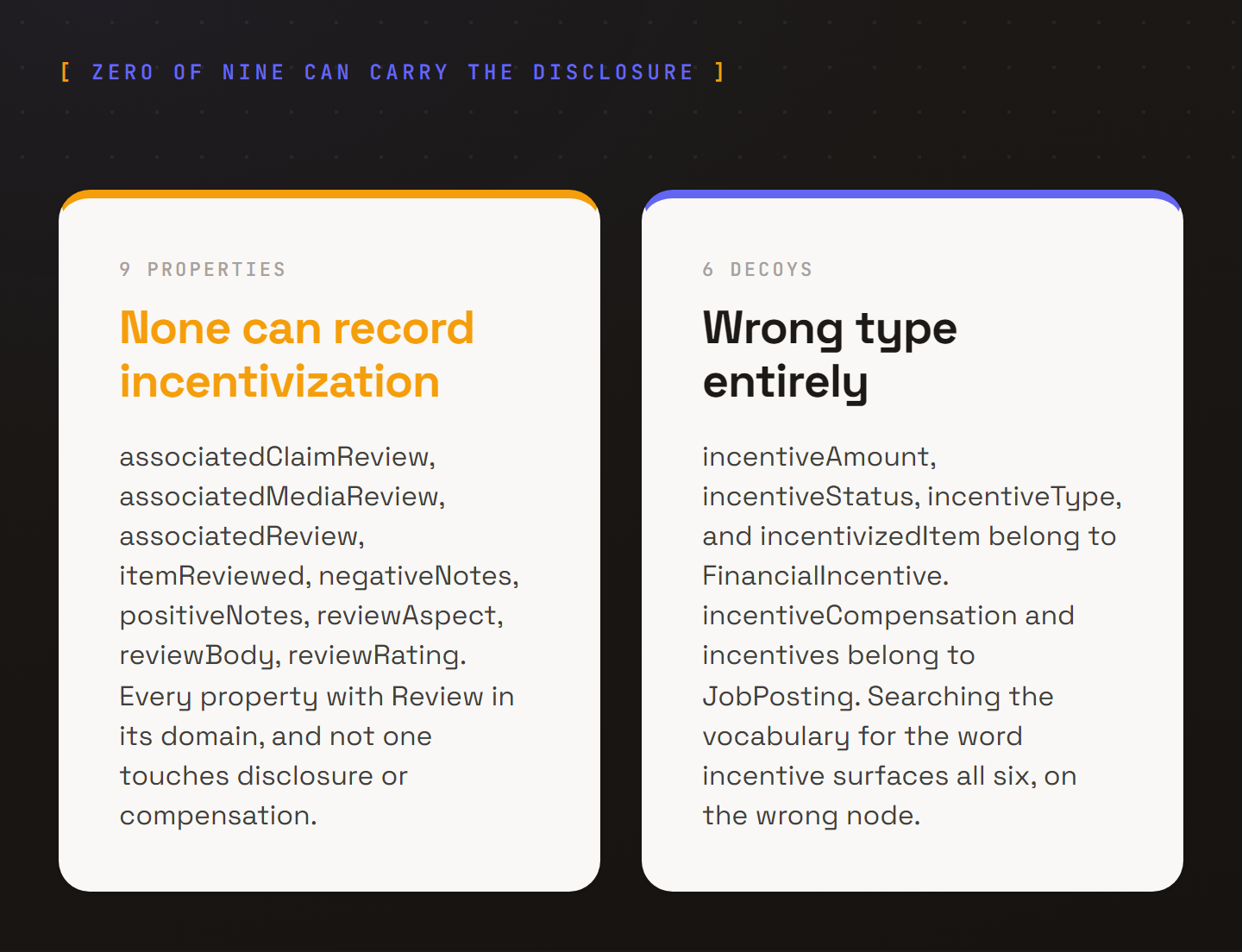
Counted directly from schema.org’s machine-readable vocabulary, fetched 2026-08-07.
Which of those nine properties could a merchant actually use on a real product page?
Fewer than the nine Review properties survive, once Google’s own eligibility restrictions apply on top of the vocabulary. Because positiveNotes and negativeNotes, the pros-and-cons format, are only eligible on an editorial product-review page, the kind where a visitor cannot buy directly, an ordinary product detail page does not qualify for that pair at all.16 associatedClaimReview and associatedMediaReview belong to fact-checking content, not customer reviews. On an ordinary purchase page, what remains is author, itemReviewed, reviewRating, and reviewBody, the free-text field for the review itself. None of those four was ever built to carry a compensation disclosure either.
What happens when Google catches an undisclosed incentivized review in your markup?
A confirmed violation costs a page its rich-result eligibility while leaving its search ranking untouched. Per Google’s general structured-data guidelines, a manual action against structured data “means that a page loses eligibility for appearance as a rich result… it doesn’t affect how the page ranks in Google web search.”3 The Manual Actions report in Search Console already lists a related issue type: reviews written by the business or service provider itself rather than by an actual customer.4 Because that same report never names undisclosed incentivization as its own category, catching it from markup alone is apparently harder than catching a review with no customer behind it at all.
Why does this land on the merchant instead of the vendor who ran the incentive program?
Because the structured data sits on the merchant’s own page, under the merchant’s own domain, regardless of who collected the review underneath it. On most e-commerce sites, a third-party review platform gathers, moderates, and serves the reviews that later get wrapped in that page’s markup, and the merchant typically cannot edit the platform’s output beyond a style sheet. What follows is an anonymized pattern from audit work rather than a measurement: a widget embedded years earlier under an incentive program nobody currently on the account can describe in detail, still running, still feeding reviews onto live pages. Because no client figures support that observation, none are offered here. The vendor-liability half of this piece reasons about who ends up holding a policy violation neither side fully controls. No dataset in this reporting run actually measures it.
A small spot check narrows the picture without settling it. On 2026-08-07, fetching two live product pages directly, one from Target and one from Nike, found neither page’s structured data carrying a Review node of any kind.78 Nike’s page used ProductGroup and Offer markup with no aggregate rating field at all; Target’s page carried no schema.org markup whatsoever, even after a full rendered fetch. Read as a sample, two pages counts as an anecdote, not a market measurement, and it says nothing about how those two retailers’ incentive programs work. What it does say is that the exposure this piece describes is uneven, concentrated on pages where a vendor’s widget already emits a Review node, while plenty of major product pages apparently carry none at all.
What can a merchant actually do about a review it knows was incentivized?
Two options exist, and neither is a real fix. By leaving the review out of structured data entirely, a merchant protects the page’s rich-result eligibility but drops that review from the exact surface Google reads and can display in search. Or a merchant can write the disclosure into reviewBody, the one property built to hold free text, where a parser extracting reviewRating and an author name has no defined field to also read out a compensation disclosure, and nowhere to put one if it did.12 Google’s own guidance never names a third path, and the vocabulary does not offer one either.
It fits a pattern worth watching across the rest of this feed-is-the-storefront pillar. Google’s Deal Ends badge runs on the same shape: a Google feature acting directly on a field, sale_price_effective_date, that schema.org has no property for either. Reviews are just the version where the missing field carries a compensation disclosure instead of a countdown.
How can you check what your own review widget puts into structured data right now?
Open one of your own product pages, view its rendered source, and read every property inside the Review or AggregateRating node your widget actually emits. If the only fields present are author, reviewRating, and reviewBody, that is the entire structured-data surface an incentive disclosure could occupy on that page, and none of it was designed to hold one.12 Should any of those reviews have come from an incentive program run by your review vendor, this is where you would look for a place to disclose that inside the markup itself. You will not find one, and the fix is not a missing field waiting to be populated. It is a decision about whether that review belongs in structured data at all.
Sources
- Google Search Central: Review snippet (Review, AggregateRating) structured data
- schema.org: machine-readable vocabulary (schemaorg-current-https.jsonld)
- Google Search Central: General structured data guidelines
- Google Search Console Help: Manual Actions report
- Google Search Central: Spam policies for Google Search
- Google Search Central: Introduction to Product structured data
- Target.com product page (JLab GO Pods ANC true wireless earbuds), fetched directly
- Nike.com product page (Air Force 1 '07), fetched directly
Recent developments
Related reading
This piece elsewhere