Most AI-Driven Site Visits Carry No Referral Tag At All
Sources: Profound; Google Search Central; OpenAI.
The short version
- A panel study joining real AI conversations to the same users' later browsing found brand-site visits running 1.5 to 2.5 times a forecasted baseline for 7 days after an assistant mentions a brand. For ChatGPT specifically, only 2.47% of downstream traffic carried a trackable AI-referral parameter by June 2026, even after a mid-2026 change made its answer links more clickable; Gemini and Google AI Overviews are never shown carrying that same rate.
- Google's Search Console gained a dedicated generative-AI impressions report in June 2026, but Google says the rollout covers only a subset of properties, and the report lists impressions, pages, countries, and devices, with no clicks.
- Recomputed from this site's own crawler log against its published classification, on-demand assistant fetches, the kind OpenAI ties to a live user request rather than routine crawling, totaled 733 of 13,178 requests over 26 days, outnumbered roughly 5 to 1 by training and search crawlers that answer no single visitor.
- This site has no session-level referral analytics and no checked Search Console access for the new report, and that gap is itself the finding a site owner without dedicated AI-visibility tooling should expect to hit.
A study that joined real AI conversations to the same users’ later browsing found brand-site visits running well above normal for seven days after an assistant mentions a brand, from 1.5 to 2.5 times a forecasted baseline depending on the platform.1 Almost none of that traffic arrived wearing a label. For ChatGPT specifically, even after its answer links became more clickable in May 2026, only about 2.5% of downstream visits carried a trackable AI-referral parameter by June.1 In the source data, Gemini and Google AI Overviews are never shown carrying that same rate. The figure most practitioners report as “AI traffic” is the small tagged tail of a much larger effect, and the untagged rest lands in direct or organic where nobody attributes it. For a site owner, planning against ChatGPT’s tagged number alone means planning against roughly one-fortieth of what that platform’s traffic actually looks like.
Even after ChatGPT made its answer links more clickable in May 2026, only about 1 in 40 downstream brand-site visits from a ChatGPT mention carried a trackable referral tag.
What did the AI-mention study actually measure?
Profound, a company that sells AI-visibility monitoring, built a double opt-in panel recording both sides of a person’s AI use: the prompts and responses exchanged with an assistant, and the pages that person visited afterward.1 Between January and June 2026 the panel logged more than 2 million AI conversations across ChatGPT, Gemini, and Google AI Overviews, then checked whether the same user later opened the mentioned brand’s own site.1
An “exposure” only counted when the AI response introduced a brand the user had not already named, which rules out the case where someone was already interested and just happened to ask about it.1 Against a baseline forecast built from that same user’s own visit rate in three prior seven-day windows, Gemini produced the largest relative lift, about 2.5 times its baseline. ChatGPT delivered the most consistent lift across industries, and Google AI Overviews carried the largest raw exposure volume.1 Across all three platforms, the direction holds, though the size of the effect varies, and Profound’s own numbers say so without rounding it away.
How big is the referral-tag undercount, and did ChatGPT’s clickability update fix it?
ChatGPT’s clickability update barely moved the referral-tag undercount, and the study’s own before-and-after numbers show why. By Profound’s own count, downstream visits carrying a matched AI-referral parameter held near 1.0% from January through April, then rose to 1.79% in May and 2.47% in June, immediately after OpenAI’s answers reportedly began showing brand links more prominently.1 Read the other way, more than 97% of the downstream visits Profound could match to a ChatGPT exposure still arrived with no trackable AI-referral parameter at all.
Profound frames the June rise as coinciding with “the early-May 2026 change that made ChatGPT answers more clickable.”1 In OpenAI’s own release notes, I looked for that change and could not find it. The entries closest to that date, May 5 and May 7, describe a memory feature and an optional safety contact tool, and neither mentions link display.4 Treat the timing as reported by an interested party rather than confirmed by OpenAI directly. A real product change producing zero primary trail to check it against is exactly the pattern this piece is about.
Why does a study from an AI-visibility vendor deserve trust here?
This study from an AI-visibility vendor deserves trust because the design holds up on its own terms, even though the source is not neutral. With products named Answer Engine Insights and Agent Analytics sitting in its own site navigation, Profound sells the same category of monitoring a finding like this would make a brand want to buy.1 That interest does not make the number wrong, but it means the design deserves a plain description rather than a summary that launders the vendor’s framing into a neutral one.
The controls are real, and Profound’s own numbers show them holding up. When a user had already searched for or visited the brand in the prior week, Profound drops that exposure from the count. The lift itself is a forecast-adjusted figure, not a raw before-and-after count. Profound builds that adjustment using a bootstrap, a statistical technique that reruns the same dataset thousands of times with items resampled at random, to estimate how much the result could shift by chance, run here across 2,000 resamples.1 In its own methodology section, Profound states plainly that the study is “not a randomized experiment” and that the design “does not fully eliminate selection bias between exposed and non-exposed users.”1 That is the source’s own hedge, not mine. Because this is inference rather than something Profound states directly, my own read is that a consenting-user panel structurally cannot see a logged-out session, a household outside the panel, or a visit from a device the panel’s software never touched. Neither the treated group nor the baseline includes any of that traffic, so the true undercount could run in either direction from what the panel reports.
What does this site’s own crawler log add to the picture?
This site’s own crawler log adds one real number instead of another study’s number. Over the 26 days this site’s own AI-crawler log covers, July 16 through August 10, on-demand assistant fetches totaled 733 of 13,178 logged requests, using the same category rules published at this site’s own /tools/ai-crawlers/ page.3 OpenAI documents that its ChatGPT-User agent fires “when users ask ChatGPT or a CustomGPT a question” and “is not used for crawling the web in an automatic fashion” because the request is “initiated by a user.”3 That is the closest thing to a live, per-visit signal any server log can produce.
With 694 of those 733 requests coming from OpenAI’s ChatGPT-User agent, the remainder splits between Anthropic’s Claude and Perplexity’s own user-triggered fetcher. Crawl-time AI traffic, the training and search crawlers that build an index rather than answer one specific question, totaled 3,890 requests over the same window, outnumbering the on-demand category by a ratio of about 5.3 to 1. Because none of those 733 fetches is a browser visit, none of them could ever pick up a referral tag, no matter how the page is instrumented. An assistant fetching a page to read it before answering is a server acting on a person’s behalf. It’s like a research assistant photocopying a report before a meeting while the client waits outside. At the point that matters most, the analogy breaks: the photocopy leaves a paper trail in the office’s own records, while a ChatGPT-User fetch leaves nothing in the visitor’s browser for any analytics tool to find. The human visit Profound’s study measures, someone opening the site afterward on their own, is a separate event this log was never built to see.
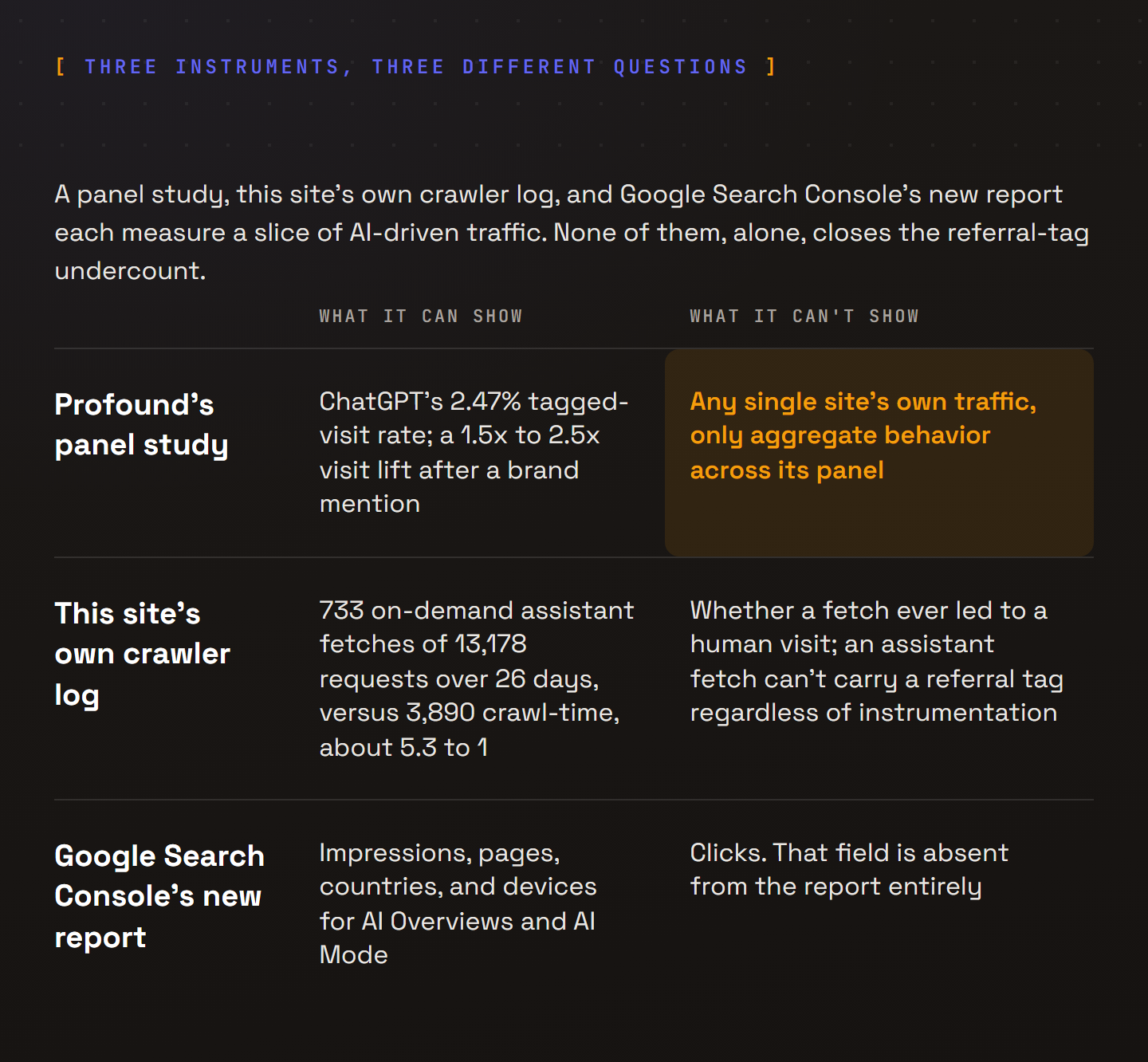
This site’s own crawler log covers July 16 through August 10, 2026; Profound’s panel study ran January through June 2026; Search Console’s report is described from Google’s own help documentation, checked 2026-08-12.
Can this site’s own analytics confirm the other two instruments?
This site’s own analytics cannot confirm the other two instruments, and reporting that plainly beats papering over it. With no session-level export that tags visits by referral source, this site keeps only a raw per-user-agent crawler log, and I have no checked access to this property’s Search Console account while drafting this piece.2 Google’s help center still describes the report the same way its June 2026 announcement did: rolling out “to a subset of website owners, allowing for thorough testing before rolling it further,” with no stated date for full availability, as of the day I checked it directly.5 On any one property, including this one, its absence would not be diagnostic on its own.
Even where the report is live, it would not close this gap by itself. Per Google’s own listing, the report shows impressions, the pages that appeared, countries, devices, and a date range.2 Clicks are not on that list. Because the two instruments answer different questions by design, a reader who does have the report live still cannot check Profound’s referral-tag number against it. One counts how often a page appeared inside an AI answer; the other counts how a visit that followed got tagged, or did not.
How is this different from an AI agent browsing while signed in?
An AI agent browsing while signed in and the undercounted visit this piece covers run in opposite directions. On this site, a companion piece, When an AI agent logs in, your analytics see a human, covers an AI agent that logs into a person’s own account and acts inside that session, which analytics record as an ordinary signed-in human because nothing in the request marks it otherwise. This piece covers a real human visit that an AI mention caused, one that arrives with no tag because the browser session itself never carried one.
What should a practitioner check on their own site this week?
A practitioner can check two things on their own site this week, and neither needs a vendor contract. First, open Search Console’s Performance report and look for the generative-AI view Google added in June 2026, a set of impression, page, country, and device figures for AI Overviews, AI Mode, and Discover’s AI features, kept separate from the standard Search results tab.2 If it is not there yet, Google has said the rollout covers a subset of properties, so its absence on any single date proves nothing by itself.
Second, pull whatever server or crawler log the site already keeps and count requests from ChatGPT-User, Claude-User, Claude-Web, and Perplexity-User, the agents each vendor documents as user-triggered rather than routine crawling.3 Alongside a near-zero count of AI-tagged referral sessions in the analytics platform, a nonzero count there is this piece’s undercount showing up in a reader’s own data. Assistants are visiting on someone’s behalf, and whatever human visit follows arrives with no way to connect the two.
In late July, in Google’s billions-of-clicks claim, I made close to the opposite argument: that the aggregate figure could not be checked against any individual site’s data at all, because Search Console showed impressions and nothing that isolated a click referred from an AI feature.2 Stated precisely rather than smoothed over, Google announced the generative-AI report in a limited beta on June 3, 2026, about eight weeks before that earlier piece even ran, restricted from the start to what Google called a subset of properties.2
Since then, what changed is visibility, not universal availability. On August 11, 2026, Search Engine Watch reported wider exposure to the report, after Search Console accounts started surfacing an in-product prompt pointing at it, while the same article’s own body still hedges to “appears to be rolling out globally” rather than confirming it.6 Google’s own help documentation, checked directly the day I wrote this, still says the same thing it said in June.5 A reader can now at least check whether their own property shows the report, which nobody could do in July. Whether every property has it, including this one, stays open, and partly closed is the honest place to leave it.
Sources
- Profound: The AI mention effect (Nikolas Laskaris, July 1, 2026)
- Google Search Central Blog: Introducing Search Generative AI performance reports in Search Console (June 3, 2026)
- OpenAI: Overview of OpenAI crawlers (bot and user-agent documentation)
- OpenAI Help Center: ChatGPT Release Notes
- Google Search Console Help: Generative AI performance report (Search)
- Search Engine Watch: Google's Generative AI report in Search Console now launched globally (Sachin Patel, August 11, 2026)
Recent developments
Related reading
This piece elsewhere